The Real Battle Began Before the Fruit
When most people consider the Fall in Eden, their attention goes straight to the forbidden fruit. It is all too natural to assume that eating the fruit was the central issue. In reality, the fruit was only the final act in a much deeper conflict. By the time Eve reached out and took it, the decisive battle had already taken place. The real struggle was not in her hand but in her mind. Her actions simply reflected a change that had already occurred in her thinking.
The story begins with what seems like an ordinary conversation. Genesis 3:1 says, “Now the serpent was more cunning than any beast of the field which the LORD God had made. And he said to the woman, ‘Has God indeed said, “You shall not eat of every tree of the garden”?’ ” (NKJV). At first, the serpent’s question seems harmless. He did not openly contradict God or urge Eve to rebel. Instead, he simply invited her to question what God had said. That subtle question was all he needed. A seed of doubt was planted where confidence in God’s Word had once existed.
How Satan Plants Doubt in the Mind
Satan’s strategy has not changed. He usually starts by encouraging people to accept God. More often, he starts by prompting them to question, reinterpret, or minimise what God has said. Long before sinful behaviour appears on the outside, the battle has already begun on the inside, in the realm of thoughts and ideas.
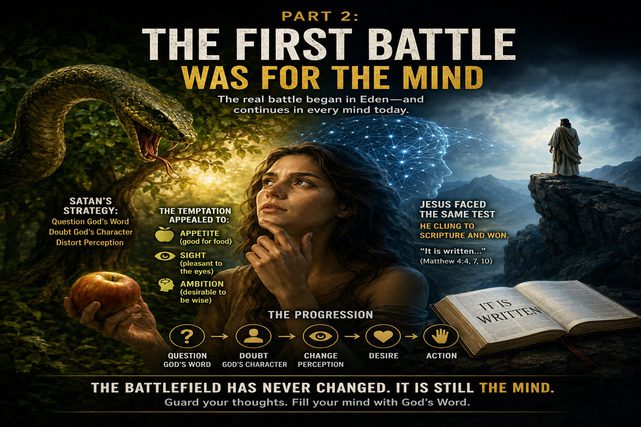
Having planted doubt about God’s Word, the serpent moved to something even more serious. He attacked God’s character. In Genesis 3:5 he told Eve, “For God knows that in the day you eat of it your eyes will be opened, and you will be like God, knowing good and evil” (NKJV). Beneath those words was a powerful accusation: God is keeping something beneficial from you. The temptation, therefore, was never simply about eating fruit. It was about trust. Would Eve trust that God truly cared for her, or would she trust the serpent’s promise that true fulfilment lay outside God’s boundaries?
Every temptation leads us to that same choice. When someone is tempted to be dishonest, the deeper question is whether God’s way can really be trusted. When a believer is tempted to seek pleasure outside God’s design, the underlying issue is whether God truly knows what is best. When a Christian feels pressured to compromise biblical convictions, the real question is whether obedience is worth the cost. Although the circumstances may differ, we continue to face the same struggle that began in Eden every day.
How Wrong Thinking Leads to Wrong Choices
The turning point in the story comes in Genesis 3:6. “So when the woman saw that the tree was good for food, that it was pleasant to the eyes, and a tree desirable to make one wise, she took of its fruit and ate” (NKJV). One detail deserves careful attention. The tree had not changed. The fruit had not changed. God’s command had not changed. What changed was Eve’s perception.
The very same tree she had seen countless times suddenly appeared different. Once she entertained the serpent’s arguments, she began to view the forbidden fruit through an entirely different lens. What had once been forbidden now seemed attractive. What had once been dangerous now appeared desirable. Before Eve ever reached for the fruit, the battle had already reshaped the way she thought.
The progression is remarkably clear. It began with questioning God’s Word, which led to doubting God’s character. That changed Eve’s perception, awakened desire, and finally resulted in action. Scripture repeatedly reveals this pattern, and life confirms it. Most people do not wake up one morning intending to destroy their lives. Marriages seldom collapse overnight. Addictions rarely begin with the goal of becoming addicted, and people usually abandon their faith gradually. More often, the process starts with a thought that is entertained instead of rejected, a compromise that seems harmless, or a voice that is listened to often enough to become convincing. Long before behaviour changes, our thinking has changed.
Why Temptation Appeals to the Human Senses
Genesis 3:6 also reveals how Satan appealed to Eve’s natural desires. She saw that the tree was ‘good for food.’ That appealed to her appetite. It was “pleasant to the eyes.” That appealed to her sense of sight. It was also “desirable to make one wise.” That appealed to her ambition and her desire for self-advancement. Satan understood human nature well. He knew that what consistently captures a person’s attention often shapes that person’s desires.
The same principle is recognised in modern society. Advertisers know that people are more likely to want something after they have seen it repeatedly. Social media platforms compete for attention because they understand that repeated exposure influences desire. Entertainment companies operate on the same principle. Before people pursue something, they usually spend time looking at it, considering it, or imagining it. Temptation rarely begins with an action. It usually begins with an attraction.
This helps explain why many believers struggle spiritually. We often underestimate the influence of what we repeatedly allow into our minds. A person who constantly consumes content that celebrates greed should not be surprised when materialism begins to shape their priorities. Someone who regularly watches entertainment that normalises immorality should not be surprised when it becomes increasingly difficult to resist temptation. Whatever consistently enters the mind will eventually influence the heart.
How Jesus Won the Battle of the Mind
Thousands of years later, Satan employed a remarkably similar strategy against Jesus. After fasting for forty days, Christ was physically weak and hungry. The devil first appealed to His appetite by saying, “If You are the Son of God, command that these stones become bread” (Matthew 4:3, NKJV). Later, he took Jesus to a very high mountain and “showed Him all the kingdoms of the world and their glory” (Matthew 4:8, NKJV). That single word, ‘showed’, is significant. Just as he appealed to Eve’s senses in Eden, Satan appealed to Christ’s senses in the wilderness. He presented something attractive. He offered an easier path. He promised glory without the suffering of the cross.
The difference lay in how each responded. Eve allowed the serpent’s words to shape her thinking. Jesus refused to let Satan define reality. Instead, He anchored His mind in Scripture. Again and again His response was the same: “It is written” (Matthew 4:4, 7, 10, NKJV). God’s Word governed His thinking, directed His decisions, and protected His mind from deception. One listened to the voice of the tempter and yielded. The other held firmly to the voice of God and overcame.
The Battle for Your Mind Continues Today
Most of us will never stand beside the tree in Eden, yet we face the same kind of conflict every day. Voices continue to question God’s Word. Messages continue to promise happiness and fulfilment apart from Him. Temptations still appeal to our eyes, our emotions, and our desires. The setting may be different, but the battlefield has never changed. It is still the human mind.
As we continue this study, we will see what happens when that battlefield is left unguarded, both in individuals and in society.